

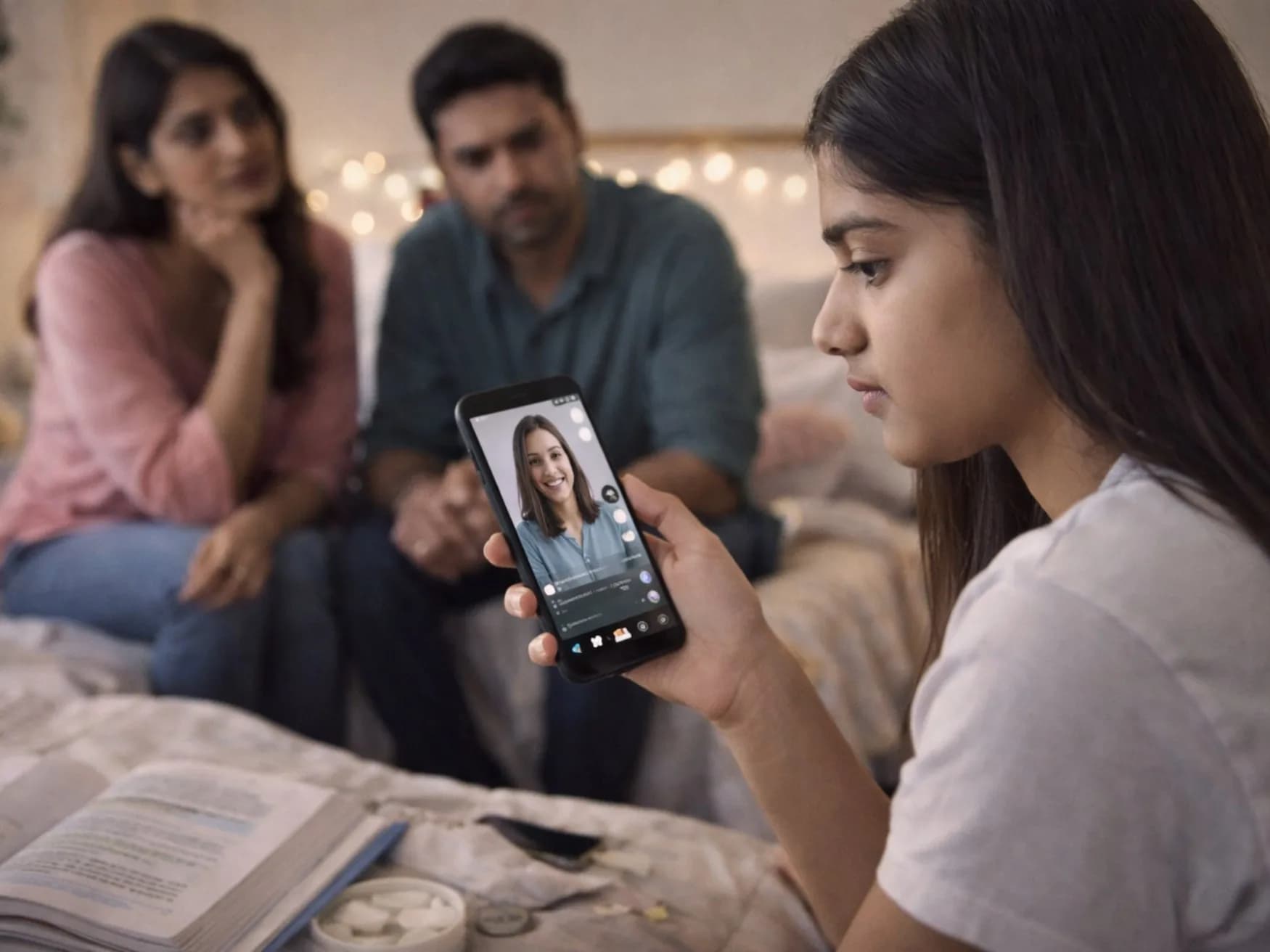
TikTok did not invent psychological distress, nor did it invent therapy. What it has done, however, is collapse the distance between clinical language and casual consumption. Concepts that once required context, training, and sustained engagement now circulate as sixty-second clips, captions, and memes. This shift has consequences, particularly for adolescents whose cognitive, emotional, and identity structures are still forming.
The question is not whether TikTok therapy exists. It does. The question is what happens when therapeutic frameworks are absorbed through an algorithm designed to reward emotional immediacy, identification, and repetition rather than nuance or containment.
What People Mean When They Say “TikTok Therapy”
When parents encounter the term therapy TikTok or tik tok therapy, they often assume it refers to licensed professionals offering advice online. In reality, the category is far broader and far less regulated.
TikTok therapy encompasses:
- short-form psychoeducation,
- mental health “relatability” content,
- diagnostic checklists,
- trauma narratives,
- therapy memes,
- and recovery language repackaged as identity markers.
The platform does not distinguish between credentialed clinicians and articulate lay creators. Authority is established through visibility, emotional resonance, and algorithmic reinforcement, not expertise.
This matters because psychological frameworks are not neutral information. They shape how individuals interpret their inner lives.
The Appeal: Why TikTok Feels Therapeutic
For adolescents and young adults, TikTok offers something traditional mental health systems often fail to provide: immediacy.
Content framed as TikTok therapy treatment appears accessible, validating, and non-pathologising. It names feelings quickly. It offers language for distress. It reduces isolation by implying universality.
In this sense, TikTok can have positive effects. Exposure to mental health language can reduce shame. It can prompt help-seeking. It can normalise emotional struggle in environments where silence previously dominated.
This is why questions like “How is TikTok good for mental health?” and “What are the positive effects of TikTok?” are not naïve. The platform does meet unmet needs.
The problem emerges when recognition is mistaken for resolution.
Where Compression Becomes Distortion
Therapy relies on context, pacing, and differentiation. TikTok relies on compression.
When complex constructs are reduced to lists, trends, or memes, they lose their clinical function and gain social meaning. Diagnoses become descriptors. Symptoms become personality traits. Coping strategies become aesthetic identities.
This is particularly evident in therapy meme TikTok, where humour flattens distinction. While memes can reduce stigma, they can also trivialise severity and encourage over-identification with distress.
Research increasingly suggests that repeated exposure to symptom-focused content can intensify self-monitoring, reinforce maladaptive schemas, and increase anxiety rather than relieve it—especially in adolescents.
Algorithmic Reinforcement and Symptom Fixation
TikTok’s algorithm is not therapeutic. It is associative.
Once a user engages with mental health content, the platform delivers more of it. Over time, this can create a feedback loop where distress is constantly mirrored back, stripped of context or progression.
This is not treatment. It is reinforcement.
Parents often notice that after exposure to TikTok therapy, their children begin to speak in diagnostic language, interpret normal stress through pathological frameworks, or resist alternative interpretations. This is not malingering. It is cognitive priming.
The Risk of Identity Solidification
One of the most under-discussed risks is identity foreclosure.
Adolescents are particularly susceptible to incorporating labels into their sense of self. When psychological language is encountered primarily through short-form content, it can become declarative rather than exploratory.
Instead of asking “What is happening to me?” the question becomes “Who am I, diagnostically?”
This is where TikTok’s influence shifts from awareness to limitation.
What TikTok Cannot Replace
No matter how articulate or well-intentioned a creator may be, TikTok cannot replicate:
- assessment,
- containment,
- longitudinal understanding,
- or therapeutic alliance.
This distinction matters when parents encounter searches like “What is TikTok therapy?” or “How many hours of TikTok a day is healthy?”
The issue is not duration alone. It is depth without grounding.
Special Cases and Misinterpretation
Some searches reveal deeper confusion, such as “What therapy is good for tics?” or references to tik tok conversion therapy, which often reflect misinformation or algorithmic conflation rather than actual treatment modalities.
TikTok does not curate accuracy. It curates engagement.
This is why clinically sensitive topics require professional containment, not crowd-sourced interpretation.
Gen Z, TikTok, and Emotional Language
When people ask “Why is Gen Z so addicted to TikTok?”, the answer is not simply dopamine. It is narrative.
TikTok offers scripts. It gives words to experiences that were previously unnamed. For a generation raised amid uncertainty, those scripts can feel stabilising.
But scripts are not solutions.
GET HELP
What Parents Can Do Without Moral Panic
The most counterproductive response is prohibition. Banning TikTok does not remove the need it is fulfilling.
Instead, parents can:
- contextualise content,
- encourage sceptical engagement,
- differentiate validation from diagnosis,
- and emphasise that understanding distress is not the same as treating it.
Most importantly, they can model curiosity rather than correction.
FAQs
What is TikTok therapy? A broad term for mental health-related content on TikTok, ranging from psychoeducation to memes, often without clinical oversight.
How is TikTok good for mental health? It can reduce stigma, provide language for emotions, and encourage help-seeking when used critically.
What are the positive effects of TikTok? Connection, normalisation of struggle, and increased mental health awareness.
How many hours of TikTok a day is healthy? There is no universal threshold; impact depends on content type, engagement style, and developmental stage.
Why is Gen Z so addicted to TikTok? Because it offers identity scripts, emotional validation, and immediacy in a fragmented cultural landscape.
What is the 3 month rule in mental health? Often misrepresented on TikTok; clinically, it refers to reassessment periods, not diagnostic timelines.
How can Samarpan help?
At Samarpan Recovery Centre, we increasingly work with parents who are confused by the rise of TikTok therapy and viral mental health content online. While therapy meme TikTok videos or short-form TikTok therapy treatment clips may normalise conversations around emotions, they often oversimplify complex psychological issues and can spread misinformation. Trends around tik tok therapy may blur boundaries between evidence-based care and unverified advice, leaving young people self-diagnosing or misunderstanding serious concerns like anxiety, trauma, or addiction. We also address the harm caused by misleading content that resembles tik tok conversion therapy, which can be especially damaging for vulnerable adolescents. Samarpan helps families navigate this digital landscape through psychoeducation, proper clinical assessments, and age-appropriate therapy that goes far beyond what TikTok can offer. We explain the difference between online trends and real treatment, helping parents understand when social media is helping awareness and when it is quietly hurting mental health. Our focus is not to dismiss online platforms outright, but to place them in context, ensuring children and teens receive structured, ethical, and research-backed care rather than relying on viral content to replace real therapy.
GET HELP